
How founders deal with rejection: Lessons from investors, customers, and startup failure

Entrepreneurship is often romanticized as innovation, freedom, and ambition. What gets discussed far less is how much of the founder's experience is built around rejection.
Founders are constantly asking people to believe in something uncertain: investors before there is traction, customers before there is trust, partners before there is proof, and employees before there is stability.
Most of the time, the answer is no, not yet, or silence.
Over time, repeated exposure to rejection becomes one of the defining psychological realities of building a company. This affects the founder personally. After enough failed pitches, ignored emails, stalled partnerships, and difficult conversations, you begin carrying rejection internally. It can slowly shape confidence, emotional stability, decision-making, and even the ability to think clearly under pressure.
If there is an unresolved emotion, whether you are aware of it or not, it will affect how you perceive your issue and respond to it. If paying attention to emotional state is not important for you, then do it for the wrong reasons, and do it for your startup.
This article explores the different forms of rejection, why entrepreneurship creates such intense psychological strain, and how you can stay resilient as you build your company.
H2: Why do founders face more rejection than most people
Employees apply for jobs after companies are established. Consultants pitch services with proven case studies. Professionals operate within systems that already have trust built in.
Founders start with almost none of that. They live in a strange reality, spending most of their time asking people to believe in things that do not exist. That alone creates rejection at a scale most people never experience.
They ask investors to believe before there is traction.
They ask partners to commit before demand is proven.
They ask customers to buy before brand trust is established.
Recent founder wellbeing surveys show how psychologically intense entrepreneurship can become. In a 2025 survey of startup founders, 83% reported experiencing high stress, 75% experienced anxiety, and 54% reported burnout within the previous 12 months.
Nearly half described their mental health as “bad” or “very bad.”
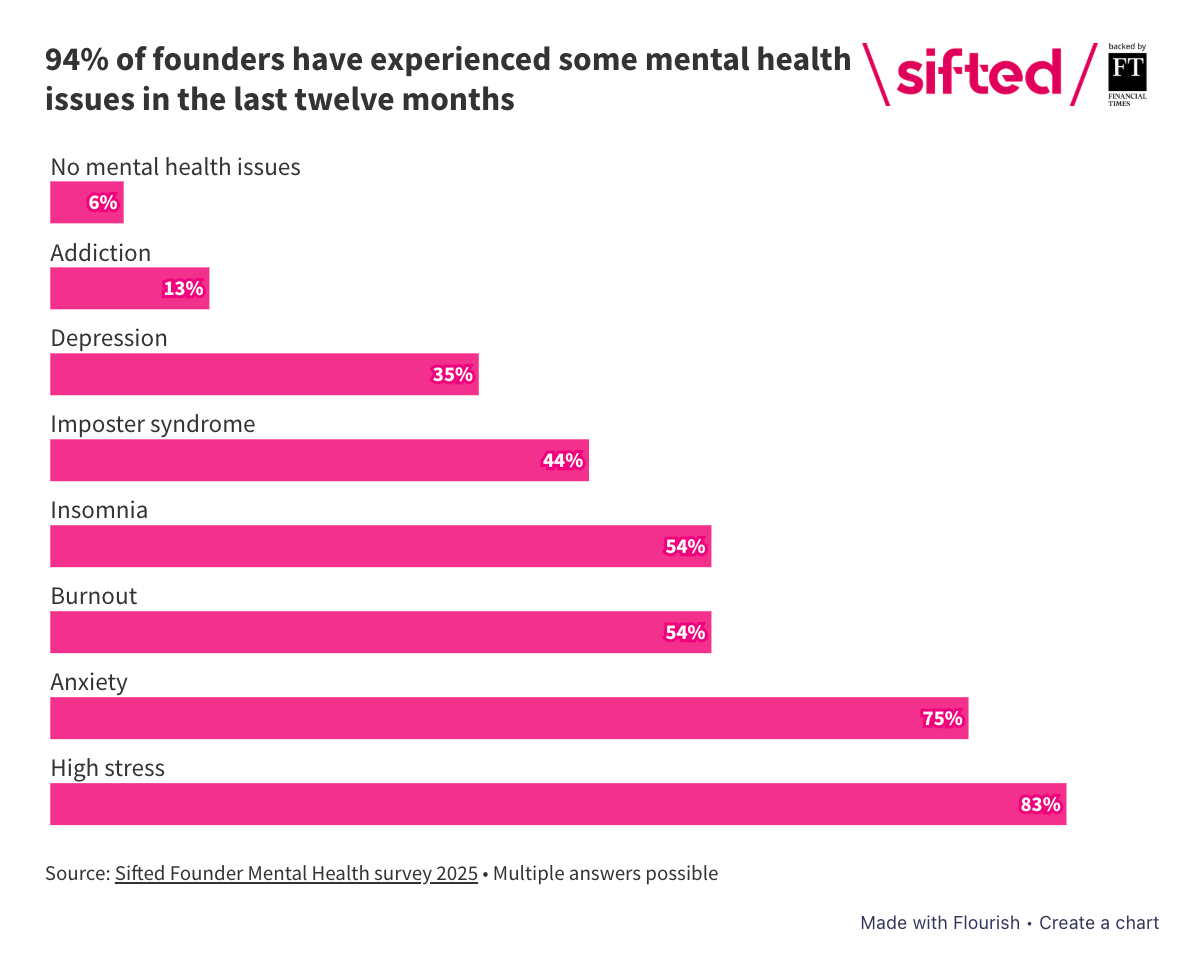
Source: More than half of founders experienced burnout last year
Investors operate the same way. Founders often assume investors are searching for innovation, but most investors are actually searching for asymmetrical risk-adjusted returns. They are portfolio managers before they are visionaries.
A “no” does not necessarily mean the idea is bad. It may mean:
- the timing feels early
- the market seems uncertain
- traction is insufficient
- the founder has not yet reduced enough risk
Even FOMO, or the fear of missing out, the famous investor instinct, usually appears only after social proof exists. Most investors do not want to be first. They want validation that someone else smart already believes.
I learned this the hard way during a meeting with an investor named Raj. I was presenting to my company and used this analogy to summarize what I was asking for.
“As you can see, we have built an airplane. Now, we just need the resources to get it into the air and make it fly.”
I didn’t get the chance to finish my sentence, as he said to me: “That’s not an airplane. It’s more like landing gear. Maybe a wheel.”
I believed we had already built something meaningful, but from his perspective, the business still lacked enough proof to justify what I was asking for. I was emotionally living in the company's future potential. He was evaluating present-day risk.
You can read the full story on Crash Course
Partners think similarly. Most companies do not want difficult growth. They want easy growth.
Founders imagine partnerships as shared ambition. In reality, many partners are optimizing for convenience, simplicity, and low operational burden. They avoid products that require customer education, new marketing efforts, or behavioral change.
But consumers rarely behave that way anymore. They constantly reject products, not necessarily because the products are bad, but because modern attention is scarce. Consumers are overwhelmed with options, distractions, and noise. New products create friction:
- uncertainty
- switching costs
- learning curves
- trust issues
- decision fatigue
You may spend years obsessing over the nuances of a product while customers give it three seconds of attention.
H2: The 5 types of founder rejection and what they mean
One of the hardest parts of entrepreneurship is that rejection rarely arrives in just one form. Founders are not only rejected by investors. They are rejected by customers, partners, potential hires, friends, and sometimes by silence itself.
Different types of rejection communicate different things. Some reveal misalignment, timing issues, or misunderstandings. Learning to distinguish between them is one of the most important founder skills.
1. Market and customer rejection
This is often the hardest rejection because it challenges your belief in the product itself. Founders understand the deeper meaning of what they build. Customers usually don’t. They evaluate products quickly, with limited attention and little emotional investment.
Sometimes, a weak market response does not always mean the product is bad. Often, it means the positioning, messaging, or distribution is unclear. The market rewards clarity, not effort.
With Plushkies, I believed we had created something much bigger than a toy. To me, it gave children a “window to the world” through storytelling, geography, and imagination. But many outsiders simply saw: “Another toy.”
2. Investor and partnership rejection
Investors reject companies for hundreds of reasons unrelated to quality. Sometimes you’re too early. Sometimes too niche. Sometimes the market feels too unfamiliar. Sometimes they simply don’t “get it.”
Partnerships work the same way. Brands, distributors, retailers, and collaborators often avoid anything that feels uncertain or unproven.
What makes this rejection difficult is that you naturally interpret it as validation of worth: “If smart people said no, maybe the business isn’t good enough.”
But investors are not judges of truth. They are judges of risk. Many successful companies looked irrational, too small, or uninteresting in the beginning. Rejection from investors usually says more about their incentives and pattern recognition than your potential.
3. Hiring rejection
Founders expect customers and investors to say no. They don’t expect candidates to reject them. Early-stage startups ask people to trade stability for uncertainty. That’s a difficult sell, especially when larger companies offer higher salaries, recognizable brands, and predictable careers.
Hiring rejection can feel especially personal because you’re asking someone to believe in your future before it exists. But candidate hesitation often reflects fear, timing, or life priorities, not disbelief in you.
4. Ghosting and silent rejections
One of the most frustrating forms of rejection is silence. Unanswered emails, an investor who seemed excited in the first discussion, and disappeared in the second minute, or partnership discussions that led to nothing.
Silence creates mental loops because there’s no closure. You start replaying conversations, looking for mistakes, wondering what they missed. But ghosting is often less dramatic than it feels. People avoid uncomfortable conversations, lose urgency, get distracted, or deprioritize opportunities. In many cases, ghosting reflects low attention rather than a strong negative opinion.
5. Social rejection
Social rejection occurs when your path no longer makes sense to those around you. Friends, family, or peers may quietly question the decision to pursue something uncertain instead of something stable and recognizable.
This rejection feels personal because entrepreneurship often strips away traditional markers of progress, such as salary, titles, or predictability. Founders temporarily trade social validation for long-term possibility, and that can create isolation long before success becomes visible.
H2: Why and how rejection affects founders psychologically
Identity fusion - when you become one with your company
For many of you, the company stops being something they build and becomes something they are. The startup reflects their intelligence, ambition, creativity, and sense of purpose. As a result, rejection no longer feels external; it feels deeply personal.
When customers reject the product or investors reject the vision, founders often interpret it as a rejection of themselves. The stronger the emotional fusion between identity and company, the harder it becomes to separate business feedback from self-worth.
Ego attachment - when criticism feels like an attack
Founders spend enormous amounts of time defending their ideas internally before presenting them externally. By the time a product launches, you are usually emotionally attached to both the idea and the belief that it should work.
That attachment can make criticism feel threatening rather than informative. Instead of hearing “this positioning is unclear,” founders may unconsciously hear “you failed.” The psychological challenge is learning how to protect conviction without becoming defensive against useful feedback.
Scarcity stress - when you operate under FOMO and high expectations
Startups operate in environments of constant scarcity: limited time, capital, attention, and opportunities. You are often surrounded by stories of hypergrowth, funding rounds, and competitors moving faster, which creates ongoing pressure to keep up.
This produces a mindset driven by urgency and fear of missing the window. Every rejection can start to feel catastrophic because founders believe there may not be another chance, investor, hire, or breakthrough around the corner.
Cortisol spike - when your body responds to every business decision
High uncertainty and repeated rejection activate the body’s stress response system, increasing cortisol levels and keeping you in a near-constant state of alertness.
Over time, this creates exhaustion, emotional volatility, sleep disruption, and decision fatigue. The nervous system begins reacting to routine business situations, emails, meetings, sales calls, and funding updates as potential threats. Many founders underestimate how much chronic stress shapes their thinking and resilience.
The psychological cost of repeated rejection
Most founders enter entrepreneurship expecting uncertainty, criticism, and failure. What they rarely anticipate is the cumulative psychological effect of repeated cycles of rejection: missed fundraising rounds, unanswered outreach, failed partnerships, customer churn, hiring losses, and constant exposure to evaluation.
When rejection becomes chronic, many founders gradually go from exploratory behavior to defensive behavior. This transition is often very subtle. If you were once concise, now you are overexplaining every idea in anticipation of skepticism. Feedback becomes harder to process objectively because criticism is experienced as a threat rather than information.
When the brain starts treating ordinary uncertainty as a threat, emotional energy becomes redirected away from strategic thinking and toward self-protection. Here is how it might show up on your journey:
- Creativity declines because creativity requires psychological openness.
- Risk tolerance decreases because you become more focused on avoiding pain than pursuing asymmetric upside. Or you go to the opposite end of the spectrum, in which you take desperate risks.
- Decision-making becomes more reactive and emotionally loaded.
- Communication lacks confidence. It's much harder to be convincing of your idea when you are the first one who’s not convinced anymore
Over time, founders may appear operationally functional while internally adapting to chronic stress.
This is why emotional exhaustion in entrepreneurship is often misunderstood. It is not simply the result of long hours or workload intensity. It is frequently the product of sustained psychological exposure to uncertainty, evaluation, and rejection without adequate recovery.
How to know when rejection means perseverance or pivoting in a different direction?
A useful distinction is pattern consistency. If rejection comes with repeated but specific signals, unclear positioning, pricing friction, the wrong audience, or weak distribution, there may still be underlying demand worth refining. But if the market consistently shows indifference even after multiple iterations, the issue may be structural rather than tactical.
The key is separating emotional persistence from strategic persistence. Great founders do not blindly ignore rejection. They study it closely, identify what is noise versus signal, and adapt without losing the ability to keep moving forward.
How to build resilience while building your company?
The founders who sustain long-term performance are not the ones who avoid rejection. You are the one who prevents rejection from destabilizing their identity, emotional state, and strategic judgment.
In practice, your resilient version is not emotionally unaffected by these challenges. You develop systems that reduce the psychological volatility created by constant uncertainty and evaluation. Rather than treating rejection as a reflection of personal value, you learn to process it as operational information.
Separate real data from self-worth
Every rejection contains two layers: emotional interpretation and actual information. Most founders merge them.
Have you failed to pitch recently? Have you already started thinking your company is not good enough, or that you are not presenting well enough?
Instead of putting all the blame on your shoulders, try asking - what are investors actually saying? What are they teaching me? Look for external outcomes, not inside your personal identity. This will help you think more clearly under pressure.
Build tolerance for repetition
Entrepreneurship is built on repetition: pitching, outreach, hiring, sales, recruiting, and fundraising. Many of their first experiences will most likely be failures.
Founders who unconsciously expect validation struggle more emotionally than founders who normalize rejection as part of the process. You already know what the worst that can happen is. Reduce your emotional shock when outcomes don’t go your way.
Avoid making decisions after rejection
One of the most dangerous founder patterns is making decisions while emotionally activated. A bad investor meeting can suddenly trigger product pivots, pricing changes, or abandoning a good idea too early.
Emotion compresses time and creates false urgency. Take some time to ponder over your discussion, let it sit overnight, and see if it still sounds like a good day a few days after.
Let me guide you through the process
The mistake many founders make is assuming that because rejection is common, it should not affect them. In reality, repeated exposure to uncertainty, criticism, and setbacks creates emotional weight that accumulates over time. Ignoring it does not make it disappear. It simply pushes it into the background, where it can quietly influence your confidence, decisions, and behavior.
When rejection happens, start by separating what you feel from what you choose to do. Then ask a second question: "What is the best decision for the company right now?"
A useful habit is to create a short recovery process after significant challenges:
- Acknowledge the emotion instead of suppressing it.
- Give yourself time before making major decisions.
- Separate feedback from self-worth.
- Look for patterns rather than reacting to individual opinions.
- Focus on the next meaningful action you can take.
Most importantly, remember that rejection is not evidence that you are failing. It is evidence that you are participating in a process where uncertainty is unavoidable.
Newsletter
Sign up for Ricardo's newsletter and receive updates and tips today.